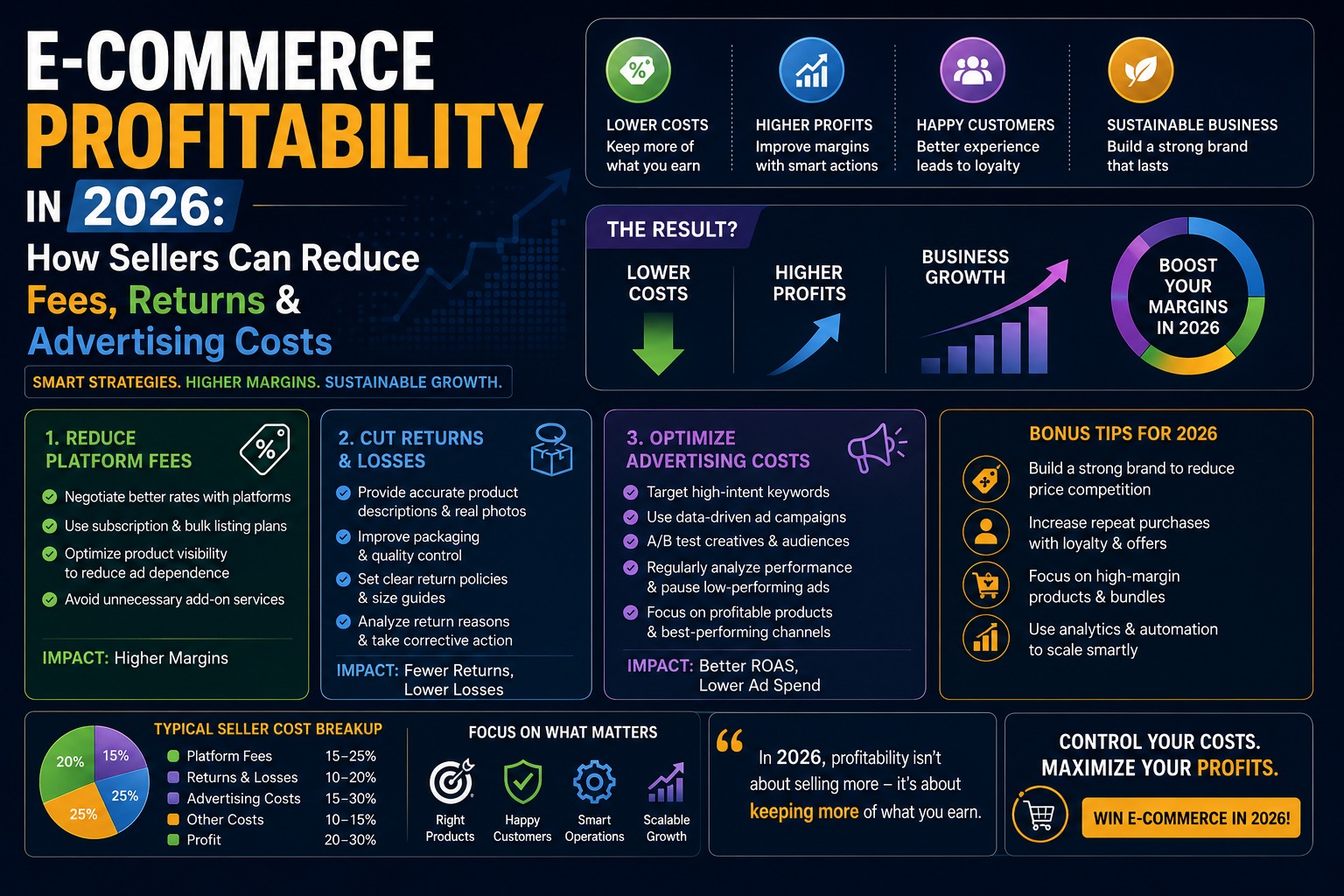
In 2026, getting more orders is no longer enough for e-commerce businesses.
A seller can generate thousands of orders and still struggle to make a healthy profit because of marketplace fees, advertising expenses, product returns, discounts, shipping costs and operational inefficiencies.
“How can I increase sales?”
to:
“How can I increase profitable sales?”
This is where a smarter e-commerce management strategy becomes essential.
Marketplaces such as Amazon, Flipkart and Meesho provide sellers with access to millions of customers, but selling on marketplaces comes with multiple costs.
Depending on the product and fulfilment model, sellers may have expenses related to:
When these costs are not monitored carefully, revenue can look impressive while actual margins remain low.
The solution is not necessarily to stop spending.
It is to spend strategically.
1. Understand Your True Profit Per Order
One of the biggest mistakes sellers make is measuring success through sales revenue alone.
For example, a product may sell for ₹1,500, but after marketplace fees, shipping, advertising, discounts, returns and product costs, the actual profit could be significantly lower.
Sellers should calculate the approximate contribution margin for every important product.
A simple approach is:
Once you know which products generate genuine profit, you can make better decisions about pricing, advertising and inventory.
2.Reduce Unnecessary Marketplace Costs
Marketplace fees can have a major impact on profitability.
Sellers Should Regularly Review:
The objective should not simply be to find the cheapest fulfilment option.
Instead, sellers should determine which combination of price, fulfilment, delivery performance and customer experience produces the best margin.
Regular fee audits can reveal products that appear successful but are actually contributing very little profit.
3.Reduce Product Returns
Returns are one of the biggest profitability challenges in e-commerce.
A returned product can create several costs, including reverse logistics, repackaging, inspection and potential inventory loss. Many returns can be reduced by improving the information customers receive before purchasing.
Optimize Your Product Listings With:
The goal is simple:
Help customers understand exactly what they are buying before they place the order. Better product information can help reduce mismatched expectations and unnecessary returns.
4.Make Advertising More Profitable
Advertising can generate sales quickly, but uncontrolled advertising can destroy margins.
Instead of asking:
“How many orders did my ads generate?”
ask:
“How much profit did my advertising generate?”
Monitor important metrics such as:
Not every product needs the same advertising strategy.
High-margin products may justify greater advertising investment, while low-margin products may require tighter campaign controls. The objective is to build profitable advertising, not simply expensive traffic.
5.Improve Product Listings to Increase Conversion
A better conversion rate can directly improve advertising efficiency.
If more visitors purchase after reaching your product page, you may generate more orders without proportionally increasing advertising spend.
Focus on:
Product Title → Images → Key Features → Description → A+ or enhanced content where applicable → Reviews → Pricing
Every element should answer an important customer question. Strong listings can help improve both organic visibility and paid campaign performance.
6.Focus on High-Margin Products
This approach helps sellers allocate advertising budgets and operational resources more effectively.
7.Improve Inventory Management
Excess inventory can tie up capital, while stockouts can result in lost sales and reduced marketplace momentum.
A profitable e-commerce operation needs a balance between:
Demand Forecasting + Inventory Planning + Reordering + Sales Trends
Monitor fast-moving products, seasonal demand and advertising-driven sales spikes.
Better inventory planning can reduce unnecessary storage costs while protecting sales opportunities.
8.Build Organic Sales Alongside Paid Sales
Long-term profitability should not depend entirely on advertising.
Sellers Should Continuously Work On:
The stronger your organic sales become, the less pressure there may be to depend exclusively on paid traffic.
A Smarter E-commerce Profitability Framework
For marketplace sellers, profitability should be managed across the entire customer journey:
Better Product → Better Listing → Better Targeting → Better Conversion → Fewer Returns → Lower Costs → Higher Profit
This is why e-commerce management should go beyond simply uploading products and processing orders.
Businesses need continuous optimization based on real marketplace data.
How Dauji Global Tech Can Help
At Dauji Global Tech, we help e-commerce businesses focus on sustainable marketplace growth—not just higher order volumes.
Our Services Can Include:
Our approach focuses on improving the complete e-commerce ecosystem—from product visibility and conversion to advertising efficiency and profitability.
Ready to Build a More Profitable E-commerce Business?
More orders do not automatically mean more profit.
In 2026, successful marketplace sellers will be the ones who understand their numbers, control unnecessary costs, reduce avoidable returns and invest their advertising budget where it generates the strongest returns.
Dauji Global Tech — Helping Businesses Grow Smarter Across E-commerce, Marketplaces & Digital Channels.